
Choosing the right diode is critical for optimizing efficiency, thermal performance, and switching behavior in modern power electronics. Two of the most common families—Schottky diodes and ultrafast recovery diodes—are often used in similar circuits, but their electrical characteristics make them ideal for very different applications.
This article provides a clear engineering explanation of both types, details their pros and cons, and finishes with a comprehensive comparison table.
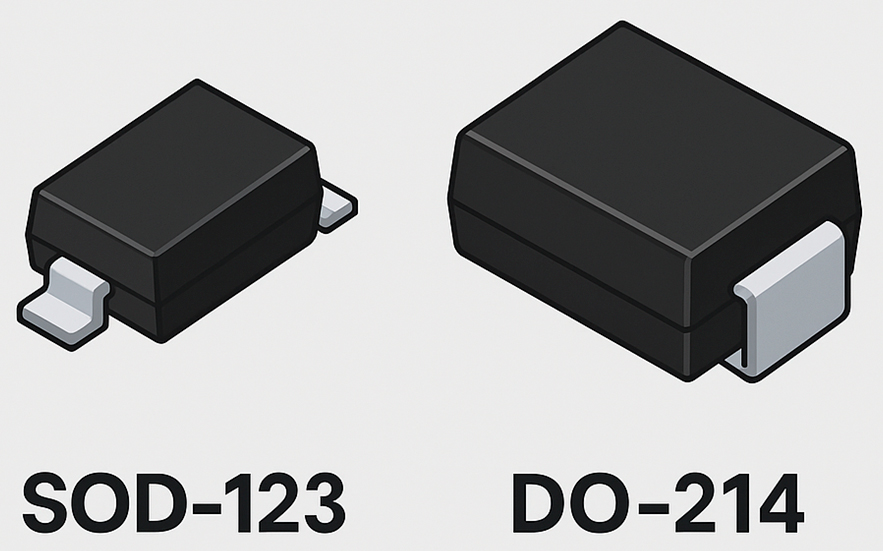
Understanding the Difference: Schottky vs. Ultrafast Diodes
Schottky Diodes
Schottky diodes use a metal–semiconductor junction that eliminates minority-carrier storage. This gives them:
- Extremely fast switching (virtually zero reverse recovery)
- Low forward voltage drop (0.2–0.5 V typical)
- Excellent high-frequency performance
However, they are limited by:
- Low reverse voltage ratings (20–200 V range)
- High leakage current that worsens at high temperature
- Lower thermal robustness
Best applications
- DC-DC buck converters
- Low-voltage SMPS outputs
- High-frequency rectification
- Solar bypass diodes
- Reverse-polarity protection
Ultrafast / Superfast Diodes
Ultrafast diodes are engineered PN junction diodes with fast reverse recovery—typically 15–50 ns.
They offer:
- High voltage capability (200–1200 V)
- Low reverse leakage
- Good thermal stability
But compared to Schottkys:
- They have higher forward voltage drop
- They still exhibit some reverse recovery
- They are slower at very high frequencies (above ~300 kHz)
Best applications
- Flyback and forward SMPS
- PFC boost rectifiers
- Motor drivers and H-bridges
- High-voltage freewheeling
- Snubber and clamp circuits
Diode Comparison Table
| Parameter | DSS310 | DSS320 | SS32 | SS54 | U1B | U1D | E2J / ES2J | UF4007 |
| Diode Type | Schottky | Schottky | Schottky | Schottky | Ultrafast | Ultrafast | Ultrafast | Standard Fast |
| Max Reverse Voltage (VRRM) | 100 V | 200 V | 20–200 V variants | 40 V | 100 V | 200 V | 600 V | 1000 V |
| Average Rectified Current (Iₙ) | 3 A | 3 A | 3 A | 5 A | 1 A | 1 A | 2 A | 1 A |
| Forward Voltage (VF) | ~0.85 V @3 A | ~0.95 V @3 A | ~0.55 V @3 A | ~0.50 V @5 A | ~0.92 V @1 A | ~0.76 V @1 A | ~1.70 V @2 A | ~1.7 V @1 A |
| Reverse Recovery Time (t_rr) | (Schottky → none) | (Schottky → none) | none | none | ~25 ns | ~15 ns | ~35 ns | ~75 ns |
| Reverse Leakage (IR) | Medium | Medium | Low | Low | Very low | Very low | Very low | Very low |
| Junction Temperature (Tj max) | 150 °C | 150 °C | 150 °C | 150 °C | 150 °C | 150 °C | 150 °C | 175 °C |
| Package | SMA | SMA | SMA/SMB | SMB | SMA | SMA | SMA/SMB | DO-41 |
| Ideal Use Case | 12–48 V rails | 48–100 V rails | Low-voltage SMPS | High-current low-V | Mid-voltage SMPS | High voltage SMPS | 300–600 V SMPS | High-voltage rectification |
| Strengths | Low VF | Higher VR | Very low VF | High current | Fast switching | Very fast recovery | High voltage | Extremely rugged |
| Weaknesses | Limited VR | Higher leakage | Low VR range | Low VR | Low current | Low current | High VF | Slow recovery |
How to Choose the Right Diode
Choose a Schottky diode if:
- Input voltage is below 200 V
- Frequency is high (200 kHz – 2 MHz)
- Efficiency is paramount
- Temperature is manageable
Best picks: DSS310, DSS320, SS32, SS54
Choose an Ultrafast diode if:
- Voltage is above 100 V
- Thermal stability is important
- You need controlled, predictable reverse recovery
- Switching frequency is moderate (20–300 kHz)
Best picks: U1B, U1D, E2J (ES2J), UF4007 (for ruggedness)
Conclusion
Schottky and ultrafast diodes each occupy a different niche in modern power electronics. Schottky diodes deliver excellent efficiency and high-frequency performance for low voltages, while ultrafast recovery diodes offer robustness and high voltage handling for demanding SMPS, motor control, and PFC applications.